





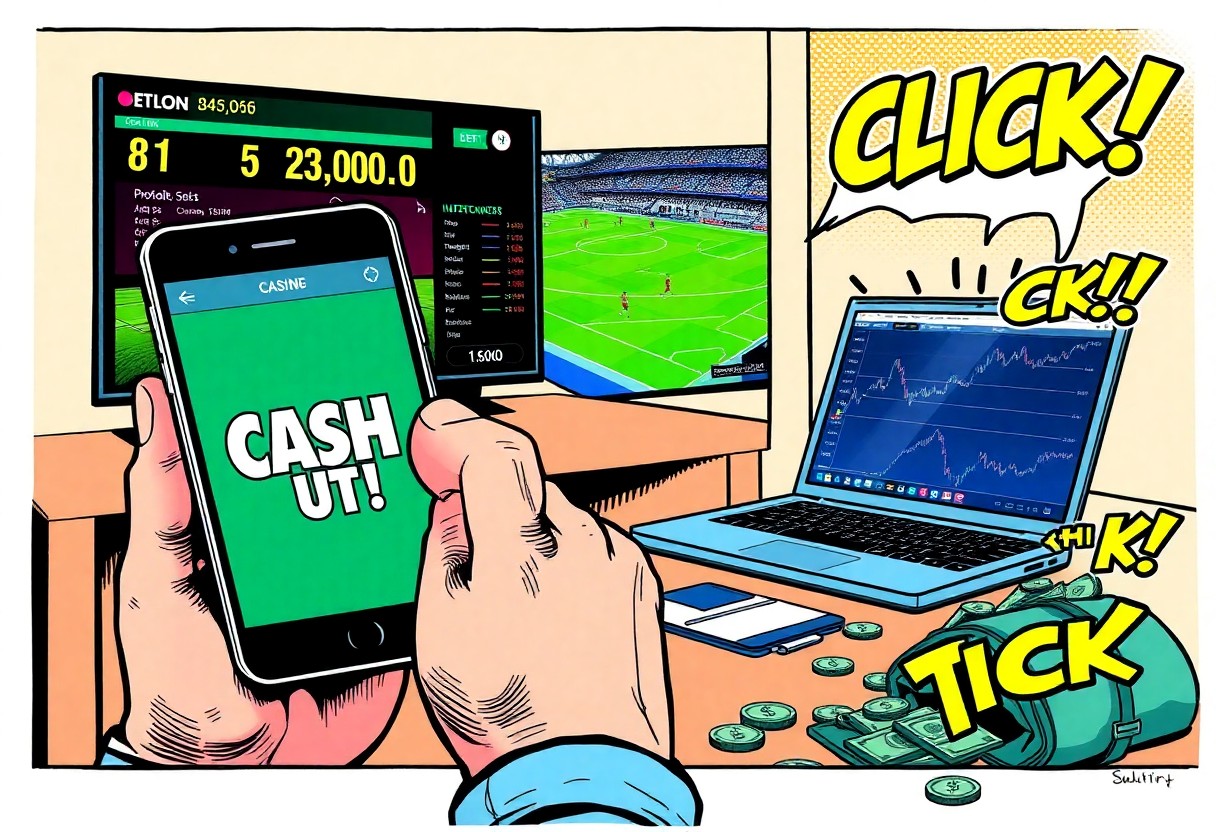
It’s necessary to understand the psychological factors influencing live cash out decisions. Emotions, risk perception, and cognitive biases play significant roles in how individuals evaluate potential gains against losses during live betting scenarios. This exploration aims to uncover the mental mechanisms at play in these high-stakes moments.

The Evolution of Sports Betting: From Static Stakes to Dynamic Markets
The transition from pre-match finality to in-play liquidity
Traditionally, sports betting revolved around fixed, pre-match bets. As events unfolded, the inability to adjust wagers created a static experience. Today, in-play betting allows for real-time adjustments, providing bettors with opportunities to cash out or alter their stakes as the game progresses.
This shift towards dynamic markets has revolutionized gambling behavior. Bettors now find themselves making decisions based on live game events, enhancing engagement and requiring quick judgments that reflect the current state of play.
Technological catalysts for real-time settlement features
Advanced algorithms and real-time data analytics have made immediate settlement of bets possible. Innovative technologies are transforming how bettors interact with the market, allowing for live cash-out options. These improvements have enabled platforms to provide instant feedback, thereby increasing user engagement.
Tools that analyze game dynamics in real time now drive betting decisions, offering insights that were previously unavailable. This tech-driven approach not only enhances user experience but also aligns betting outcomes more closely with the live event.
High-frequency data processing has pushed the boundaries of sports betting. Systems now quickly respond to changes in gameplay, allowing for instantaneous cash-out opportunities and precise betting adjustments. Technological advancements have fundamentally altered how bettors engage, making them feel like active participants in the outcome rather than passive spectators.
Market penetration and the normalization of the “Early Exit”
As in-play betting gains popularity, the concept of the “Early Exit” has become commonplace. Bettors increasingly opt for cashing out before a game concludes, driven by both strategy and emotional factors. This shift reflects a broader acceptance of dynamic betting practices across the sports community.
Embracing this approach has normalized cash-out features, allowing bettors to mitigate risks and secure profits while a game unfolds. The gambling culture is evolving, prioritizing flexibility and instant gratification over traditional betting models.
This acceptance of early exits has been facilitated by widespread market penetration, leading to a collective understanding among bettors of its advantages. As more platforms integrate this feature, cash-out options shape betting strategies, with users adeptly balancing potential risks and rewards as they adjust their wagers throughout the game.
Prospect Theory and the Weight of Potential Losses
Loss aversion: Why the pain of losing outweighs the joy of winning
Loss aversion suggests that individuals feel losses more intensely than equivalent gains. Research indicates that the emotional impact of losing $100 is often perceived as more significant than winning $100. This disparity drives players to avoid situations where losses are possible, heavily influencing their decision-making processes during live cash-out scenarios.
Choosing options that minimize potential losses can overshadow the excitement of potential wins. This psychological bias may lead players to cash out early to ensure they don’t experience losses, even if it means sacrificing larger potential gains.
The certainty effect and the preference for guaranteed outcomes
The certainty effect emphasizes that people tend to favor certain outcomes over uncertain ones, even when the expected value is lower. This tendency manifests in live cash-outs, where players often choose guaranteed returns over riskier, higher potential rewards. The allure of a sure outcome can significantly sway decision-making during gameplay.
Guaranteed outcomes provide a sense of security that outweighs the thrill of uncertainty. Players often perceive cashing out as a way to safeguard their current standing, aligning with the instinctive drive to avoid losses.
Preferences for secure choices reflect a broader psychological tendency toward risk aversion. With a guaranteed cash-out, players reduce anxiety and uncertainty, enabling them to focus on the immediate gains rather than stressing over potential losses. This behavior underscores the importance of perceived security in financial decisions.
Diminishing sensitivity to incremental gains in live scenarios
Diminishing sensitivity indicates that as gains increase, the actual emotional response to each successive gain lessens. In live cash-out situations, early wins can evoke strong positive feelings, yet subsequent gains may not elicit the same level of excitement. This reduction in emotional impact can encourage players to prioritize cashing out sooner rather than risking bigger investments.
As players engage in live scenarios, the excitement from earlier successes may wane, leading to a preference for immediate cash outcomes over pursuing further gains. Understanding diminishing sensitivity can provide insights into their cash-out decisions, revealing a complex interplay of emotions and economic reasoning.
The Neurobiology of Real-Time Decision Making
The role of the amygdala in processing immediate financial threat
Amygdala activation occurs swiftly when individuals face potential financial losses. This brain region plays a key role in emotional responses, particularly fear and anxiety, triggering a fight-or-flight reaction. Heightened amygdala activity often leads to impulsive decisions driven by the instinct to avoid perceived threats.
Dopaminergic responses to fluctuating potential payouts
Prefrontal cortex exhaustion and the breakdown of rational analysis
The Illusion of Control and Agency in Live Events
Active involvement as a catalyst for perceived predictive skill
Active engagement during live events can lead individuals to overestimate their predictive abilities. Observing every play fosters a sense of involvement, encouraging bettors to believe they possess unique insights. This perceived mastery enhances their confidence, often influencing cash out decisions even in unpredictable situations.
Perception of control stems from interactive participation. Viewers might rationalize that their analytical skills outweigh the inherent randomness of the game. Consequently, this false sense of agency can lead to impulsive cash-out choices as they attempt to exert influence over the outcome.
The psychological impact of “watching the game” on cash out timing
Immersion in live action heightens emotional investment, impacting when bettors choose to cash out. As excitement peaks, individuals may act impulsively, prioritizing immediate satisfaction over calculated decisions. This emotional undercurrent can skew rational judgment, pushing them to either hold on too long or cash out prematurely.
Observing pivotal moments amplifies anxiety and thrill, creating a binary decision-making process. The urgency of the game unfolds, compelling bettors to react swiftly, often at the expense of thoughtful evaluation of their positions.
Counterfactual thinking: Managing the “what if” scenarios
Counterfactual thoughts-considering alternative outcomes-can deeply affect cash out decisions. Bettors often reflect on past games, questioning what might have happened if they had chosen differently. This mental exercise can either induce regret or reinforce self-confidence, influencing their future betting behavior.
Exploring these “what if” scenarios becomes a double-edged sword. While some bettors may learn from past mistakes, others become trapped in a cycle of self-doubt and justification, impacting their approach to cashing out in future events.
Cognitive Biases Influencing the Cash Out Trigger
The Anchoring Effect: Fixation on the initial stake or peak offer
The anchoring effect plays a significant role in cash-out decisions. Players often fixate on their initial stake or the peak offer they observe, leading to suboptimal choices. When a specific figure becomes the reference point, any subsequent offers can seem inadequate, regardless of their actual value.
Surprisingly, this cognitive bias can distort perceptions of future risks and rewards. Sticking to an anchor may prevent players from assessing all available options effectively, leading to premature cashing out when more favorable outcomes could be possible.
The Endowment Effect: Overvaluing the current winning position
The endowment effect causes players to perceive their current winning position as inherently more valuable than it is. This bias leads to reluctance in cashing out, as individuals assume that their winnings should be protected and maximized. Holding onto perceived gains can inhibit objective decision-making.
This phenomenon is particularly evident in high-stakes situations. Players often inflate the worth of their temporary success, believing they can ride the momentum for even greater rewards, which can ultimately backfire.
Overvaluing a winning position often leads individuals to dismiss logical assessments about the likelihood of future gains. Emotional attachment to wins can cloud judgment, pushing players to hold on longer than they rationally should, which may culminate in losses instead of securing a modest but profitable cash-out.
The Gambler’s Fallacy: Misinterpreting momentum and event probability
The gambler’s fallacy manifests when players mistakenly believe that recent outcomes influence future events. This misinterpretation leads to faulty judgments about momentum, causing players to assume that a winning streak will continue or that losses will balance out. Such beliefs can dangerously delay cash-out decisions.
As a result, this subconscious reasoning often compels individuals to take undue risks. Players may ignore the statistical probabilities, leading to a false sense of security about their streak or losses, ultimately affecting their cash-out strategy.
Gambler’s fallacy reflects a misunderstanding of independence in random events. Each outcome stands alone, yet many players cling to the belief that previous results shape future occurrences. This confusion can compromise effective decision-making, prompting players to chase losses rather than opting for strategic cash-outs when favorable opportunities arise.
Emotional Regulation and the Mitigation of Regret
Anticipatory Regret and the Fear of a Late-Game Reversal
Anticipatory regret influences many players, prompting them to act before potential losses materialize. Fear of a dramatic shift in game outcomes can lead to premature cash-out decisions, as players seek to avoid the sting of losing a secured profit. This psychological undercurrent can overshadow rational evaluation of ongoing play.
Players often picture scenarios where their initial victory turns to loss, which amplifies the desire to secure funds early. This emotional response to potential future regret shapes how decisions unfold, especially when stakes are high late in the game.
The “Relief Response” as a Primary Motivator for Early Settlement
Relief emerges as a powerful motivator for players cashing out early, as it offers immediate escape from anxiety surrounding potential losses. The prospect of losing the accumulated gains can propel players to act, ultimately prioritizing emotional comfort over maximizing returns.
Seeking that sense of relief often leads players to cash out sooner, prioritizing their mental well-being over the uncertain outcomes that might follow. Maintaining control over emotions plays a significant role in this decision-making process.
The immediate gratification derived from the relief response can overshadow more calculated strategies aimed at securing larger profits. Understanding this emotional trigger highlights the interplay between mental states and financial behaviors in gaming situations.
Emotional Hedging: Using Cash Out to Manage Psychological Volatility
Emotional hedging involves strategically using cash-out options to mitigate the psychological highs and lows experienced during gameplay. Players often utilize cash-out opportunities to instill a sense of control, effectively managing the stress linked to fluctuating game results.
Options to cash out provide a buffer against emotional volatility, allowing players to anchor themselves amid uncertainty. This technique not only stabilizes emotions but also influences how risk is perceived throughout the gaming experience.
Understanding emotional hedging reveals a tactic that transcends mere monetary considerations, as players strive for psychological steadiness. Emotional stability emerges as a primary objective, guiding cash-out decisions amidst the unpredictable waves of gaming.
The Impact of Heuristics under Time Pressure
The Availability Heuristic: Recalling recent dramatic late-game losses
Recent experiences heavily influence decision-making, particularly in high-stakes environments. When bettors remember instances of dramatic late-game losses, these vivid memories can skew their risk assessment during live cash-out decisions. Consequently, negative outcomes tend to overshadow rational evaluations, leading to overly cautious choices.
Emotional connections to these memorable failures amplify their psychological impact. As bettors recall these scenarios, fear of repeating past mistakes often precipitates hasty cash-out decisions, overriding potential gains.
The Representativeness Heuristic: Stereotyping team behavior in crunch time
Assessing a team’s likelihood of success during critical moments can be warped by stereotypes. Observers often rely on mental shortcuts, assuming past performances will predict future behaviors. As a result, a team’s reputation can significantly influence bettors’ choices, regardless of the current game context.
Patterns perceived from earlier games lead to biased forecasts, potentially distorting the true odds. These stereotypes, while sometimes accurate, can lead to impulsive decisions that may not reflect the situation at hand.
Analysis of teams in clutch scenarios reveals that familiarity often breeds misjudgment. Stereotypes about how teams behave under pressure can lead to flawed risk assessments, intertwining psychological bias with betting strategies. Understanding these heuristics can provide insight into why decisions might stray from statistical reasoning.
Affect Heuristic: How current mood dictates risk tolerance
Mood significantly influences risk perception during betting. Bettors feeling optimistic may take greater risks, while those experiencing anxiety tend to withdraw. A positive emotional state can create an overconfidence bias, leading to riskier cash-out decisions.
Emotions shape cognitive evaluations, often clouding the rational analysis required for optimal decision-making. Under time pressure, this heuristic becomes even more pronounced, influencing outcomes in unpredictable ways.
Emotional states create a feedback loop where current feelings drive decisions, magnifying the impact of immediate experiences. As bettors navigate through time-sensitive moments, understanding this connection between mood and risk can illuminate their decision-making processes.
Environmental Design and the Gamification of Exit Strategies
The psychology of UI/UX: Color, placement, and the “Cash Out” button
Colors and placement of elements in UI/UX design directly influence user behavior. Bright colors, particularly greens and yellows, often evoke positive emotions and signal potential gains, making the “Cash Out” button more enticing. Strategic placement, typically near the action buttons, simplifies the decision-making process, encouraging users to opt for immediate rewards.
Psychological principles dictate that positioning the button in prominent display areas enhances visibility, increasing the likelihood of clicks. Patterns from user interaction studies show that easily accessible buttons reduce cognitive load, allowing users to act quickly on their cash-out decisions.
Visual cues and the perception of urgency through live animations
Live animations can convey urgency, nudging users towards swift decision-making. These visual cues create a dynamic experience that can manipulate perceptions of time and value, making the cash-out option seem more time-sensitive. Consequently, users may feel compelled to act quickly to avoid perceived losses.
For instance, animated graphics or countdown timers effectively enhance emotional responses, pushing users towards immediate action rather than deliberative choices. This design approach maximizes engagement and reinforces a sense of urgency around cashing out.
Push notifications and the disruption of long-term betting strategy
Push notifications interrupt users at critical moments, potentially derailing established betting strategies. These reminders create an environment where short-term gains overshadow long-term goals, impacting decision-making processes. Frequent alerts encourage impulsive cash-out tendencies, undermining the rationale behind strategic betting plans.
In essence, these notifications minimize users’ ability to assess their overall betting performance. As a result, impulsivity increases, transforming what could have been a calculated decision into a snap judgment driven by immediate notifications.
The Mathematical vs. Psychological Value Gap
Calculating the “Vig”: Understanding the operator’s margin in cash out offers
The vig, or vigorish, reflects the operator’s edge in cash out situations. Operators typically set odds that create a margin, ensuring they remain profitable over time. This margin is crucial for determining whether a cash out offer genuinely represents fair value for players.
Careful analysis reveals that the vig can create a disparity between perceived and actual value. When players accept cash out offers, they often overlook this margin, favoring immediate liquidity over long-term gains. Recognizing the vig can help bettors make informed decisions.
Subjective Utility: Why a sub-optimal mathematical decision feels rational
Many individuals base their decisions on emotional satisfaction rather than mathematical logic. This tendency leads to the acceptance of cash out offers that may not maximize potential returns. The feeling of securing a known outcome often overrides the allure of potential larger gains.
Players often subconsciously justify opting for lower cash out amounts. This behavior stems from a desire for certainty, making sub-optimal choices feel like rational decisions in the moment. Understanding this psychological bias can illuminate common pitfalls in cash out strategies.
Decisions surrounding cash out offers are frequently influenced by subjective utility. A player might prioritize the emotional relief of securing any profit, viewing it as a rational choice despite potential losses on the table. This cognitive bias encourages individuals to sidestep mathematical reasoning in favor of immediate gratification, illustrating a crucial disconnect between perceived value and actual return.
The Price of Certainty: Quantifying the cost of peace of mind
Certainty often comes at a price, especially in cash out scenarios. Players are willing to forfeit potential winnings for the peace of mind that accompanies guaranteed returns. This cost can be substantial, as margin calculations and potential earnings reveal a stark contrast to the security participants crave.
Understanding this trade-off involves acknowledging that the desire for immediate resolution frequently outweighs the pursuit of optimal outcomes. Such preferences drive individuals to cash out, ultimately sacrificing potential gains for psychological comfort.
The price of certainty resonates deeply with bettors. Players frequently weigh the psychological benefits of guaranteed profits against the tangible losses they may incur. This inclination toward immediate rewards underscores the complex interplay between feelings of security and financial logic, marking a key consideration in the cash-out decision-making process.
The Psychology Behind Live Cash Out Decisions
Social Proof: The Influence of Betting Communities and Tipsters
Betting communities create a unique dynamic where social proof can heavily influence decisions. Members often share tips and opinions, leading to herd behavior that impacts individual cash-out choices. Observing others making successful bets can instill confidence or provoke anxiety about missing out on potential gains.
- Successful predictions lead to trust in shared information.
- Peer pressure can push individuals to hold bets longer.
- Information exchange shapes collective decision-making.
The reliance on social validation may overshadow personal judgment.
The Fear of Missing Out (FOMO) on a “Safe” Profit
Fear of missing out (FOMO) plays a significant role in cash-out choices. When a profitable bet hangs in the balance, the anticipation of potential profit can create anxiety about making the wrong move. This pressure often pushes bettors to hold on longer, driven by the hope of maximizing returns.
Caught in the moment, individuals assess the situation not just for potential profit, but also for the emotional toll of regret. The anticipation of securing a “safe” profit can skew rational decision-making, leading to choices based more on fear than analysis.
Bragging Rights vs. Financial Gain: The Social Cost of a Lost Lead
Social dynamics can complicate the decision to cash out, particularly when status is at stake. Some bettors prioritize bragging rights over financial gain, often leading to detrimental choices in high-stakes situations. Losing a strong position can have both economic repercussions and emotional costs tied to social perception.
Pursuing validation through successful bets can eclipse sound financial reasoning. The desire to showcase expertise and avoid embarrassment often prevails, complicating the cash-out decision process.
Temporal Discounting and the Value of Time
Hyperbolic Discounting: Preferring Immediate Smaller Rewards Over Delayed Larger Ones
Hyperbolic discounting illustrates how individuals often choose smaller, immediate rewards over larger, delayed gains. Research shows that this tendency reflects our psychological bias toward immediacy, affecting financial and decision-making scenarios, particularly in gambling contexts.
This behavior highlights the discomfort associated with waiting, leading players to cash out early rather than risking potential losses. As excitement peaks, the allure of immediate gratification can overshadow the value of future gains, influencing decisions profoundly.
The “Closing Minutes” Effect and the Escalation of Decision Anxiety
The “Closing Minutes” effect manifests as time dwindles, heightening anxiety surrounding decision-making. Players feel increased pressure to act, knowing their options will soon vanish. This urgency skews rational thought, often triggering emotional responses that lead to impulsive actions.
Time’s proximity to a deadline exacerbates this phenomenon, as players grapple with the fear of missing out while attempting to maximize their outcomes. Such heightened anxiety can prompt rash decisions, further complicating the cash-out process.
This escalation in anxiety during the closing moments influences not just immediate choices but also long-term perceptions of risk and reward. As time runs short, players weigh the potential regret of not cashing out against the thrill of remaining in play, thereby intensifying decision pressure.
Time-Decay Models and Their Psychological Counterparts in Player Perception
Time-decay models illustrate how perceived value diminishes as deadlines approach, aligning closely with individual psychology. Such models suggest that the closer individuals are to a decision point, the less value they attribute to options available, pushing them toward quicker choices.
Research indicates that this temporal perception can lead players to undervalue future potential outcomes, often opting for immediate cash-outs despite the risks involved. Perception heavily shapes decision-making, illustrating how psychological factors intertwine with logical economic models.
Understanding the influence of time-decay models on player perception reveals deeper insights into decision-making strategies. Players often grapple with conflicting emotions as the clock ticks down, determining their cash-out strategies based on perceived urgency rather than objective value.
Personality Profiles and Risk Predispositions
Sensation Seeking: High-arousal players vs. risk-averse strategists
Sensation seekers thrive on excitement and unpredictability, often favoring high-stakes environments. These players are more likely to make aggressive cash-out decisions, motivated by adrenaline rather than rational analysis.
In contrast, risk-averse strategists prioritize stability and careful planning. They tend to cash out when ahead, focusing on preserving their bankroll and minimizing potential losses, demonstrating a more calculated approach to decision-making.
Locus of Control: Internal vs. external attribution in betting success
Players with an internal locus of control believe their actions directly impact outcomes, fostering a sense of ownership over their betting decisions. Such individuals often engage in careful analysis before cashing out, viewing their choices as critical to their success.
Conversely, those with an external locus attribute results to luck or external factors. This mindset can lead to impulsive cash-out decisions, as players may feel less responsible for their actions, resulting in erratic betting behavior.
Players’ belief systems significantly influence their betting behavior. An internal locus of control encourages accountability, leading to systematic strategies, while an external locus often results in a passive approach, where outcomes are accepted without critical evaluation. Understanding these mindsets is necessary in predicting cash-out behaviors and overall performance in betting contexts.
The impact of impulsivity on long-term profitability and bankroll management
Impulsivity can severely undermine long-term profitability in betting. Players who act on impulse often make erratic cash-out decisions, disregarding their established strategies and bankroll limits. This pattern of behavior ultimately leads to financial instability and increased risk of loss.
Consistent discipline in decision-making is crucial for effective bankroll management. Those who can temper impulsivity with deliberation often find greater success, as they are more likely to adhere to budgets and avoid significant financial pitfalls.
Impulsivity directly correlates with poor bankroll management, as it encourages players to deviate from planned strategies. Setting clear boundaries and adhering to a structured approach can mitigate these tendencies. Cultivating self-control allows bettors to make informed decisions, enhancing their chances of maintaining a profitable betting trajectory over time.
Ethical Considerations and the Future of Live Settlement
The exploitation of cognitive vulnerabilities by betting operators
Betting operators often exploit cognitive biases, such as the illusion of control and loss aversion, to manipulate player decisions. By designing interfaces that create a false sense of agency, these platforms lead players to believe they can influence outcomes, despite the randomness involved. This exploitation not only impacts decision-making but can reinforce harmful betting behavior.
Behavioral nudges, such as frequent notifications and limited-time offers, further trap players in a cycle of impulsive betting. These tactics capitalize on immediate emotional responses, steering users away from rational assessments of their choices. Awareness of these practices is necessary for both players and regulators to mitigate risks.
Transparency in algorithm-driven offer fluctuations
Transparency is important in understanding how algorithm-driven offers change within live betting platforms. Many systems utilize complex algorithms that assess user behavior, often leading to fluctuating cash-out options that can confuse players. Without clear explanations of these mechanisms, players might struggle to recognize whether offers reflect fair evaluations or manipulative tactics.
Offering detailed insights into the criteria affecting cash-out offers can empower players to make more informed decisions. Clear communication surrounding algorithm changes would promote trust between betting platforms and users, encouraging responsible betting practices.
Strengthening player protection through behavioral data analysis
Analyzing behavioral data can significantly enhance player protection measures. By tracking engagement patterns, operators can identify at-risk behavior and implement tailored interventions to promote responsible gambling. This approach not only safeguards individual players but also encourages a healthier betting environment overall.
Data-driven insights allow for timely interventions such as deposit limits or personalized warnings. Comprehensive analysis can also help regulators draft more effective policies, ensuring that player welfare remains a priority in an evolving betting landscape.
To wrap up
Taking this into account, live cash out decisions are influenced by a blend of emotional and cognitive factors, such as risk perception and immediate gratification. Players assess their circumstances, weighing potential gains against the fear of loss, often leading to impulsive choices.
Behavioral finance plays a significant role, highlighting how biases like loss aversion shape decision-making. Understanding these psychological dynamics provides valuable insights into consumer behavior in gambling and betting contexts, revealing underlying motivations beyond mere numerical analysis.
Q: What psychological factors influence live cash out decisions?
A: Psychological factors include the perceived value of potential winnings versus losses, risk tolerance, and the influence of peer behavior. Emotions such as fear or excitement can distort judgment, leading to impulsive decisions.
Q: How do cognitive biases affect these decisions?
A: Cognitive biases like loss aversion can lead individuals to irrationally hold out for larger payouts. Confirmation bias may result in selective attention to past wins, diminishing the perceived risks associated with cashing out.
Q: What role does situational context play in cash out choices?
A: The environment, including time pressure, peer influence, and recent outcomes, can shape decision-making. High-stakes settings often amplify stress, altering risk perception and potentially leading to quicker cash outs than in calmer situations.