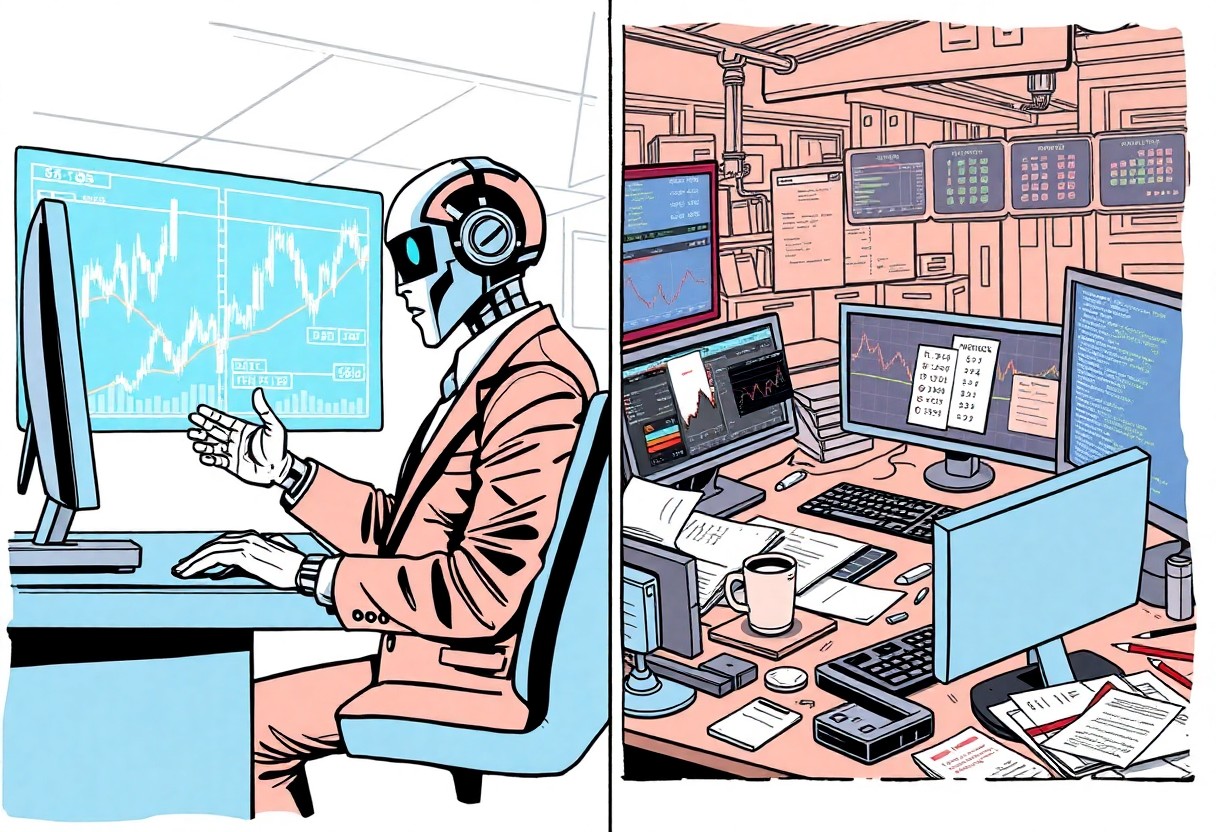
Over recent years, machine learning has transformed trading practices, pitting advanced algorithms against seasoned human traders. This article explores the strengths and weaknesses of both approaches, providing insights into their respective impacts on market performance and decision-making efficiency.
The Evolution of Trading Paradigms
From Open Outcry to Electronic Exchanges
Trading began with open outcry, where buyers and sellers shouted their orders in a chaotic, physical marketplace. This method relied heavily on human interaction and was characterized by its immediacy and lack of technological aids.
Advancements in technology led to the emergence of electronic exchanges, which revolutionized trade execution. Automation streamlined transactions, resulting in faster, more efficient trading, while reducing human error and mitigating the emotional influences often inherent in open outcry environments.
The Rise of Quantitative Analysis and Systematic Trading
Quantitative analysis introduced a data-driven approach, enabling traders to analyze vast amounts of information with mathematical models. Systematic trading strategies emerged, using algorithms to execute trades based on predefined criteria.
This shift transformed decision-making processes, allowing traders to operate with greater precision and speed. Data-centric strategies increased the capability to identify opportunities in real-time, marking a significant evolution in trading practices.
Quantitative analysis provides systematic trading with a framework for strategy development. Traders leverage statistical methods to identify patterns and correlations in market behavior, evolving from intuition-based methods to models grounded in empirical data.
Transitioning from Rule-Based Systems to Predictive Modeling
Rule-based systems offered a structured approach to trading, relying on predefined conditions for market entry and exit. As data availability expanded, predictive modeling emerged, shifting focus from rigid rules to dynamic, data-inspired predictions.
Traders began to adopt machine learning techniques, allowing algorithms to learn from historical data and adapt strategies. This transition enhanced responsiveness to market fluctuations and introduced a level of sophistication previously unmatched by static trading rules.
Predictive modeling allows traders to continuously refine strategies based on new data inputs, enhancing adaptability. This method promotes a more refined understanding of market dynamics compared to traditional rule-based systems, leading to increased profitability and reduced risk exposure.
Foundations of Machine Learning in Finance
Supervised Learning: Regression and Classification for Price Prediction
Supervised learning techniques, including regression and classification, play a pivotal role in price prediction within financial markets. By training models on historical data, these methods forecast future price movements, allowing traders to identify potential investment opportunities.
Regression analyzes numerical relationships between variables, projecting expected prices, while classification categorizes assets based on predefined labels. These approaches equip traders with actionable insights, improving decision-making in a rapidly changing environment.
Unsupervised Learning: Clustering Market Regimes and Dimensionality Reduction
Unsupervised learning focuses on discovering patterns in data without predefined labels. This method effectively identifies market regimes, grouping similar behaviors that could signal investment strategies.
Dimensionality reduction techniques streamline complex data sets, enhancing analysis without losing critical information. By simplifying data, traders can more easily interpret market conditions, making more informed choices.
Unsupervised learning significantly enhances market analysis by elucidating hidden structures in massive data sets. Techniques such as clustering allow traders to recognize patterns, fostering an understanding of market dynamics that may not be immediately apparent. Dimensionality reduction further aids this understanding, transforming complex information into more interpretable forms, crucial for making strategic investment decisions.
Reinforcement Learning: Optimizing Execution and Order Routing
Reinforcement learning involves algorithms that learn optimal trading strategies through trial and error. By maximizing cumulative rewards, these models adapt to changing market conditions, enhancing execution efficiency.
Optimizing order routing becomes possible as these systems evaluate various strategies, finding the best paths for transactions. This capability enables traders to minimize costs and improve trade execution times.
Reinforcement learning’s iterative nature allows it to adaptively refine trading strategies based on real-time feedback. As market conditions shift, these models continuously learn, ensuring that decision-making remains agile and responsive, which is imperative for maintaining an edge in competitive financial environments.
The Psychology of Human Trading
Cognitive Biases: Loss Aversion, Overconfidence, and Recency Bias
Cognitive biases play a significant role in human trading behavior. Loss aversion leads traders to prefer avoiding losses over acquiring equivalent gains, often resulting in overly cautious strategies. Overconfidence can exacerbate this, causing traders to underestimate risks while overestimating their own abilities, frequently resulting in poor decision-making.
Recency bias influences traders to give undue weight to recent events, often distorting their judgment. This bias can result in erratic trading patterns, as recent gains or losses skew perceptions of future performance, creating a cycle of impulsive reactions rather than informed strategies.
The Role of Intuition and Qualitative Assessment in Non-Linear Events
Intuition often informs trading decisions, especially during non-linear market events. Human traders can assess qualitative factors such as news sentiment, geopolitical developments, and market emotions, which machines may overlook. This qualitative insight allows traders to adapt swiftly to rapid changes.
Intuition, combined with experience, enables traders to identify patterns and anomalies that quantitative models may fail to capture. These subjective insights can lead to unique opportunities that align with market trends, enhancing the trader’s decision-making process amid uncertainty.
Combining intuition with qualitative assessments allows human traders to navigate unpredictable market conditions more effectively. Intuitive judgment often emerges from years of experience and exposure to various market cycles, empowering traders to make nuanced decisions even when data is ambiguous. Such a blend of instinct and analysis can prove advantageous when rapid, complex events disrupt traditional models, highlighting human adaptability in volatile scenarios.
Impact of Emotional Intelligence on Long-Term Strategy and Discipline
Emotional intelligence profoundly influences a trader’s long-term success. Understanding one’s emotions can enhance self-regulation, leading to more disciplined trading strategies. Traders with high emotional intelligence can maintain focus, resisting impulses that might derail their plans.
Moreover, empathy enables traders to understand market psychology, cultivating a strategic approach to trading. This insight assists in recognizing when to hold firm in a strategy or pivot in response to market sentiment, ultimately promoting consistent performance over time.
Emotional intelligence enhances long-term trading strategies by enabling better self-awareness and regulation. Traders adept at managing their emotions are less likely to make impulsive moves based on fear or greed, fostering a disciplined approach that aligns with their strategic objectives. As emotional awareness grows, so does the ability to anticipate market reactions, leading to informed decisions that support sustained success.
Data Processing and Information Arbitrage
Leveraging Alternative Data: Satellite Imagery and Sentiment Analysis
Alternative data sources, including satellite imagery and sentiment analysis, offer unique insights that traditional metrics often miss. Satellite images can reveal real-time information about supply levels or economic activity, while sentiment analysis taps into social media and news to gauge market sentiment.
These tools provide an edge in identifying trends before they become apparent in conventional datasets. Traders utilizing these insights can react swiftly, enhancing their trading strategies and capitalizing on opportunities that may otherwise remain unnoticed.
Computational Speed and the Processing of High-Frequency Datasets
Rapid data processing is a hallmark of machine learning algorithms, enabling them to analyze high-frequency datasets at unprecedented speeds. This computational advantage allows for real-time trade execution based on minute fluctuations in market data.
Competitors in the trading space use this speed to exploit tiny price differentials, often executing thousands of transactions in seconds. This efficiency transforms the way markets operate, making it challenging for human traders to compete on sheer speed.
Processing high-frequency datasets involves intricate algorithms capable of crunching vast amounts of information almost instantaneously. The ability to analyze patterns, detect anomalies, and execute trades at lightning speed defines the competitive edge for algorithmic trades in today’s markets.
Human Capacity for Contextual Synthesis and Filtering Market Noise
Humans excel at synthesizing complex information and providing context that algorithms often overlook. Understanding market sentiment and macroeconomic indicators allows traders to make nuanced decisions based on qualitative factors.
This ability to filter out market noise enables human traders to focus on viable investment strategies, mitigating risks associated with pure data-driven decisions. Drawing on experience and intuition, successful human traders navigate through chaotic market environments more adeptly.
Contextual synthesis in trading empowers human traders to consider variables beyond numerical data. Emotional intelligence combined with market knowledge allows them to interpret signals and trends holistically, facilitating better decision-making in uncertain conditions.
Algorithmic Strategies and Systematic Execution
Mean Reversion and Trend Following in Automated Systems
Mean reversion strategies capitalize on the assumption that asset prices will revert to their historical averages. Automated systems can identify these points efficiently, executing trades at speeds beyond human capacity. By utilizing statistical models, these systems effectively determine entry and exit points based on historical price movements.
Trend following, conversely, involves identifying upward or downward trends in asset prices. Automated strategies excel in maintaining positions as trends develop, ensuring trades are executed without delay. Algorithms programmed with advanced pattern recognition can adjust parameters dynamically, maximizing profit potential during strong market movements.
Identifying Arbitrage Opportunities in Fragmented Global Markets
Identifying arbitrage opportunities requires monitoring disparities in asset prices across different markets, a task well suited for automated systems. Algorithms can scan vast datasets in real-time, detecting inefficiencies that human traders may overlook. This speed and accuracy allow for quick execution before the opportunity disappears.
Various methods of arbitrage exist, from spatial arbitrage across international exchanges to statistical arbitrage within a single market. Automated systems can streamline this process, executing multiple trades simultaneously to capitalize on price differences, thus enhancing profitability.
In fragmented global markets, automated systems utilize sophisticated algorithms to pinpoint arbitrage opportunities that arise from market inefficiencies. By analyzing price discrepancies across exchanges and time zones, these systems can initiate trades at unprecedented speeds. Speed remains imperative in this context; the faster a system reacts, the more likely it is to exploit fleeting opportunities before they correct.
Statistical Arbitrage and Pair Trading at Massive Scale
Statistical arbitrage involves exploiting pricing inefficiencies between related securities. Automated platforms can efficiently handle large datasets, generating trading signals based on complex statistical relationships. This capability allows for rapid execution and adjustment to market conditions, optimizing yields substantially.
Pair trading, a subset of statistical arbitrage, focuses on the relative performance of correlated stocks. Automated algorithms can assess historical correlations and execute trades simultaneously, minimizing risk while capturing profits from the spread. The scalability of these systems makes them particularly effective in generating returns in varying market conditions.
Massive scale in statistical arbitrage and pair trading hinges on the ability to process extensive datasets quickly. Automated systems can analyze numerous pairs simultaneously, swiftly identifying those that exhibit historic correlation breakdowns. By executing trades across multiple asset classes, these algorithms enhance market efficiency and mitigate risks associated with market volatility.
Risk Management Architectures
Automated Stop-Loss Mechanisms and Dynamic Position Sizing
Automated stop-loss mechanisms dynamically adjust positions based on real-time market conditions. Incorporating algorithms allows for immediate reaction to adverse movements, minimizing losses without the delay associated with human decision-making.
Dynamic position sizing adds another layer of risk control, adapting exposure based on volatility metrics. Machine learning models can optimize position sizes, balancing risk and potential reward, ensuring portfolios remain aligned with strategic goals.
Human Oversight during Tail-Risk Events and Black Swan Scenarios
Human traders bring intuition and contextual awareness to tail-risk events, often identifying unforeseen risks that algorithms might overlook. Complex market conditions can challenge automated systems, requiring human judgment to interpret data comprehensively.
Situations characterized by high uncertainty, like Black Swan events, demand a flexible approach beyond algorithmic rigidity. Traders can adapt strategies on-the-fly and make decisions based on qualitative insights, adding a crucial layer of depth to risk management.
Human oversight proves indispensable during extreme market fluctuations, where automated models may struggle. Traders can assess geopolitical factors or market sentiment that might not be easily quantifiable, offering insights that data alone cannot. This adaptability enhances overall risk management in unpredictable scenarios.
Stress Testing and Monte Carlo Simulations in Machine Models
Stress testing within machine models examines portfolio resilience under extreme conditions. By applying severe market shocks, these simulations help identify vulnerabilities that could impact a trader’s strategy.
Monte Carlo simulations provide a statistical approach to risk assessment, generating thousands of potential outcomes based on historical and hypothetical data. This methodology allows traders to forecast risks and make informed decisions without relying solely on past performance.
Implementing stress testing and Monte Carlo simulations in machine learning models allows for comprehensive risk analysis. By exposing algorithms to various scenarios, traders can gauge how well their strategies would perform under different market conditions. This proactive approach enhances understanding of potential weaknesses, informing adjustments that improve long-term performance.
Pattern Recognition and Market Anomalies
Deep Learning and Neural Networks in Time-Series Forecasting
Deep learning techniques, particularly neural networks, excel in processing complex, nonlinear patterns in financial time-series data. A layered architecture allows these systems to identify and adapt to intricate market dynamics, improving prediction accuracy over traditional models.
Utilizing vast datasets, neural networks learn from past performance, adjusting continuously. This adaptability makes them potent tools for recognizing trends and anomalies that human traders might overlook.
Identifying Hidden Correlations Across Multi-Asset Classes
Machine learning models can analyze relationships across various asset classes, revealing connections that may not be immediately obvious. These algorithms process large volumes of data, identifying patterns that inform trading strategies.
Insights generated from these correlations offer traders an edge, as they can implement informed decisions based on a broader market understanding instead of focusing solely on individual asset performance.
Identifying hidden correlations has become increasingly important as markets evolve. Through advanced analytics, machine learning can pinpoint subtle links between assets that human intuition might miss. Discovering these connections allows for more comprehensive portfolio management and risk assessment strategies.
Human Recognition of Structural Shifts and Macroeconomic Pivots
Humans excel in recognizing structural shifts and macroeconomic pivots due to their ability to interpret contextual nuances and sentiment. Experienced traders can leverage their intuition and awareness of global events to forecast pivotal market changes.
Fundamental analysis, enriched by real-world knowledge, empowers traders to react quickly to macroeconomic indicators, placing them in a unique position to capitalize on shifts before machine-driven models can adapt.
Human expertise encompasses judgment and instinct that algorithms, despite their analytical prowess, lack. This human ability to perceive broader economic narratives influences decision-making in ways that data-driven models alone cannot replicate.
High-Frequency Trading and Market Infrastructure
The Physics of Finance: Colocation and Fiber Optic Latency
Colocation involves placing trading servers in close proximity to exchange data centers to minimize latency. This physical distance directly affects the speed at which trades are executed, often measured in microseconds. Traders investing in colocation services gain a competitive edge, as even the smallest delays can result in substantial financial losses.
Fiber optic connections play a crucial role in high-frequency trading. These cables transmit data at the speed of light, enhancing communication efficiency between traders and exchanges. Reduced latency translates directly to improved trading outcomes, allowing algorithms to react more swiftly to market changes.
Order Book Dynamics and Liquidity Provisioning by Bots
Order books are central to market operations, displaying all buy and sell orders in real time. Bots systematically analyze and respond to this data, providing liquidity by placing orders that fill gaps, ensuring smoother market functions. Their rapid adaptability allows them to capitalize on immediate price movements, influencing overall market liquidity.
Liquidity provisioning by bots has transformed how assets are traded. With algorithms constantly assessing market conditions, they can execute trades at speed and volume unimaginable to human traders. This dynamic results in tighter spreads, making it more efficient for participants to enter and exit positions without significant price impact.
Traders have increasingly relied on bots for order book activity, resulting in fundamental changes to traditional trading methods. Algorithms can analyze vast amounts of market data, responding instantly to shifts. Consequently, this reliance diminishes the role of manual trading strategies, pushing human traders to adapt or potentially withdraw from competitive roles.
The Displacement of Human Floor Traders by Execution Algorithms
Execution algorithms have effectively replaced many traditional roles occupied by floor traders. These automated systems, capable of processing and executing trades at lightning speed, often outperform human counterparts. As technology advances, the demand for human intervention declines, leading to a significant shift in market dynamics.
Human floor traders once thrived on intuition and personal interaction, but execution algorithms now dominate these functions. Automated systems analyze market trends, detect anomalies, and execute trades independently. As they gain efficiency, the necessity for skilled human traders diminishes, reshaping the trading environment into a landscape primarily governed by technology.
The Black Box Problem and Model Interpretability
Transparency Challenges in Complex Deep Learning Architectures
Complex deep learning models often limit transparency due to their intricate structures. Interpretability becomes increasingly difficult as layers and neurons multiply, obscuring how decisions are made. Users struggle to grasp these models, undermining trust and broader acceptance.
Understanding model behavior relies on simplifying approximations or surrogate models that may overlook important factors. This challenge raises concerns over the reliability of predictions and decision-making among traders who require clarity in understanding algorithmic outputs.
Regulatory Demands for Algorithmic Accountability and Audit Trails
Regulatory bodies are increasingly emphasizing accountability in algorithmic trading. Traders must maintain comprehensive audit trails that document decision-making processes and model behavior. This practice not only aligns with compliance but also builds trust with stakeholders.
Implementing such accountability measures can be resource-intensive, compelling firms to invest in systems that capture detailed logs of algorithmic actions. As regulations evolve, organizations face pressure to ensure their trading practices meet standards for transparency and ethical conduct.
Balancing Predictive Power with Human Understandability
Striking a balance between powerful predictive capabilities and human comprehensibility remains a key challenge. Models that excel in accuracy often compromise interpretability, leaving traders uncertain about decision-making processes. Simplifying algorithms without sacrificing performance is important for fostering user confidence.
Finding this equilibrium is increasingly critical as traders seek to understand risks associated with machine-generated decisions. By prioritizing transparency, organizations not only enhance trust but also enable better risk management practices.
Adaptability and Generalization in Volatile Markets
Overfitting Risks and the Dangers of Backtesting on Historical Data
Overfitting occurs when machine learning models become too tailored to historical data, capturing noise rather than underlying patterns. This leads to inflated performance metrics that don’t translate to real-world scenarios. Relying solely on past data may misguide traders, resulting in significant financial losses during unforeseen market shifts.
Building models that merely reflect historical trends can give a false sense of security. Dangers emerge when these overfit models encounter market conditions they have not been trained on, ultimately failing to adapt and respond effectively. Continuous refinement and external validation are necessary to mitigate these risks.
Transfer Learning and Domain Adaptation for Changing Volatility Regimes
Transfer learning allows models to use knowledge gained in one context to improve performance in a different but related context. This adaptability becomes crucial in volatile markets, where past patterns may no longer hold. By fine-tuning existing models with new data from evolving market conditions, traders can maintain relevance.
Domain adaptation further amplifies this process, enabling systems to generalize their learning to unfamiliar volatility regimes. Techniques such as data augmentation and regularization help reinforce model robustness, allowing them to respond more dynamically to sudden market shifts.
Human Creativity in Developing Novel Strategies for Unprecedented Environments
Creative thinking facilitates the development of innovative trading strategies that machines may overlook. Humans can synthesize disparate insights from various fields, crafting unique approaches to tackle rapidly changing market conditions. This capacity for original thought is necessary during crises when standard models falter.
Human traders often employ intuition and experience, marrying quantitative data with qualitative insights. Their ability to think outside established frameworks enables them to pivot strategies in real-time, responding to unforeseen challenges in ways that automated systems cannot replicate effectively.
Ethical and Regulatory Implications
Market Manipulation Risks and Algorithmic Collusion
Market manipulation presents a significant risk with the rise of automated trading systems. Algorithms can execute trades at speeds and frequencies unimaginable for human traders, creating opportunities for collusion among systems that may engage in coordinated activities. Such practices not only distort market pricing but can also undermine investor trust in the financial system.
Concerns around transparency multiply as these algorithms operate under opaque conditions. Without adequate oversight, traders could exploit loopholes, leading to regulatory challenges and necessitating a reevaluation of existing frameworks to ensure fairness and accountability in market practices.
Addressing Bias in Automated Decision-Making Systems
Bias in decision-making algorithms can perpetuate existing inequalities, affecting the fairness of trades and investments. Training data that reflects human biases may lead to skewed trading strategies, unintentionally disadvantaging certain market participants. Continuous monitoring is imperative to identify and rectify these biases promptly.
This issue demands collaboration between technologists and ethicists to develop transparent models that ensure equitable outcomes. Algorithm design must include safeguards against bias, promoting inclusivity in market participation and protecting marginalized groups from systemic discrimination.
Global Regulatory Frameworks for AI Integration in Capital Markets
Regulatory frameworks for AI in capital markets face the challenge of balancing innovation with risk management. Jurisdictions around the world are developing policies to govern automated trading systems, with a focus on consumer protection and market integrity. Adaptation of regulations will likely vary significantly based on regional priorities and market dynamics.
Creating unified global standards could facilitate cross-border investment while ensuring that all market participants adhere to ethical trading practices. Thoughtful collaboration among regulatory bodies may lead to streamlined guidelines that respect local contexts while promoting a fair and transparent trading environment.
The Hybrid Approach: Centaur Trading
Combining Human Heuristics with Machine Precision
Humans bring unique intuition and emotional intelligence to trading, often picking up on subtleties that algorithms may overlook. Complex market dynamics can benefit from human judgment, which can adapt strategies based on evolving contexts. In contrast, machine learning algorithms analyze mountains of data with precision, generating insights and identifying patterns that inform decision-making.
This synergy creates a hybrid model where traders can rely on their instincts while harnessing the analytical power of machines. Optimizing trades using both human insight and machine intelligence allows for more informed and timely decisions, ultimately enhancing performance.
The Rise of the Quantamental Trader in Modern Hedge Funds
Quantamental traders blend quantitative modeling with fundamental analysis, positioning themselves as versatile players in hedge funds. Combining these approaches allows for a deeper understanding of market conditions, leading to more holistic strategies. This hybrid methodology enhances traditional investment practices and adapts to rapidly changing market environments.
As the demand for real-time insights grows, quantamental trading is gaining traction. By integrating data-driven decision-making with qualitative insights, funds are better equipped to capture opportunities while managing risks effectively.
The term “quantamental” reflects a growing recognition that neither pure quantitative nor strictly fundamental analysis is sufficient alone in today’s markets. This approach capitalizes on the strengths of both methodologies, utilizing data analytics to complement in-depth market research. Investors benefit from a comprehensive view, enhancing their ability to navigate complexities and make informed decisions.
Human-in-the-Loop Systems for Enhanced Decision Support
Human-in-the-loop systems integrate machine learning capabilities with human oversight, allowing traders to intervene at crucial moments. These systems enable users to validate machine-generated predictions, ensuring crucial insights align with human intuition. Continuous feedback loops enhance the accuracy of machine learning models over time.
Collaboration between humans and algorithms fosters improved decision-making that is both dynamic and responsive. This model guards against over-reliance on machines while still harnessing their efficiency to refine outcomes and strategies.
Human-in-the-loop systems present an opportunity to blend human expertise with technological efficiency, creating a more adaptive trading environment. By allowing traders to influence algorithmic processes, firms can mitigate blind spots that might arise in fully automated systems, ensuring that strategies remain relevant and contextually informed.
Comparative Performance and Empirical Evidence
| Metric | Institutional Humans | Machines |
|---|---|---|
| Sharpe Ratio | 0.95 | 1.10 |
| Sortino Ratio | 1.05 | 1.25 |
Sharpe and Sortino Ratios: Institutional Humans versus Machines
Institutional human traders often demonstrate competitive Sharpe and Sortino ratios, indicative of sound risk-adjusted returns. However, machines consistently outperform in both metrics, evidencing more efficient decision-making processes in volatile conditions.
This outperformance highlights a key advantage of machine learning over traditional human capabilities. The reliance on data-driven strategies allows for quicker adjustments in real-time, maximizing profit potential while minimizing risks.
Analysis of Drawdown Duration and Recovery Cycles
Longer drawdown durations characterize human traders, often attributed to emotional biases and slower reaction times. In contrast, machines exhibit shorter drawdown periods, thanks to their ability to analyze data and execute trades without hesitation.
Recovery cycles also reveal significant differences; machines recover more swiftly from losses due to their systematic approach to portfolio management. This efficiency can enhance overall performance in challenging market conditions.
Understanding the differences in drawdown duration and recovery cycles provides insight into the behavioral patterns of human traders versus machines. While humans can show resilience through experience, their emotional reactions often hinder rapid recovery, leaving machines to capitalize on market inefficiencies more effectively.
The Long-term Sustainability of Alpha in an AI-Dominated Landscape
Questions arise regarding the sustainability of alpha as machine learning strategies proliferate. The competitive edge that machines provide may dilute distinct advantages over time, leading to market equilibrium.
New challenges will present themselves for human traders, including the need to adapt and innovate in rapidly evolving environments. Without distinct strategies, the long-term survival of human trading may be increasingly threatened.
Assessing the long-term sustainability of alpha requires consideration of how both machines and humans can coexist. As AI capabilities expand, continuous learning and strategy refinement will be critical for human traders seeking to remain relevant and competitive amidst rising machine-driven efficiencies.
Conclusion
On the whole, machine learning algorithms demonstrate superior speed and analytical capabilities compared to human traders, enabling them to process vast amounts of data instantly. Their ability to identify patterns and execute trades without emotional bias often results in more consistent performance.
Human traders, however, excel in interpreting complex market dynamics and dealing with unforeseen events, employing intuition and experience that algorithms can’t replicate. The combination of both approaches may lead to a more balanced trading strategy, harnessing the strengths of each in the financial markets.
Q: What are the main advantages of machine learning in trading?
A: Machine learning algorithms can analyze vast amounts of data quickly, identifying patterns that may not be visible to human traders. Speed and accuracy in executing trades can be significantly higher with machines. Predictive models can enhance decision-making based on historical trends and market behavior.
Q: How do human traders add value compared to machine learning models?
A: Human traders possess intuition and contextual understanding that machines lack. Emotional intelligence allows them to react to market news and geopolitical events more effectively. Experience provides insights beyond data analysis, enabling nuanced strategies that adapt to unexpected changes.
Q: Can machine learning replace human traders entirely?
A: Full replacement of human traders is unlikely. While machine learning excels in data processing and pattern recognition, human intuition and experience remain vital in complex and volatile markets. A hybrid approach, combining both machine learning and human judgment, often yields better results.